
Discovering the Living Campus in Tooting
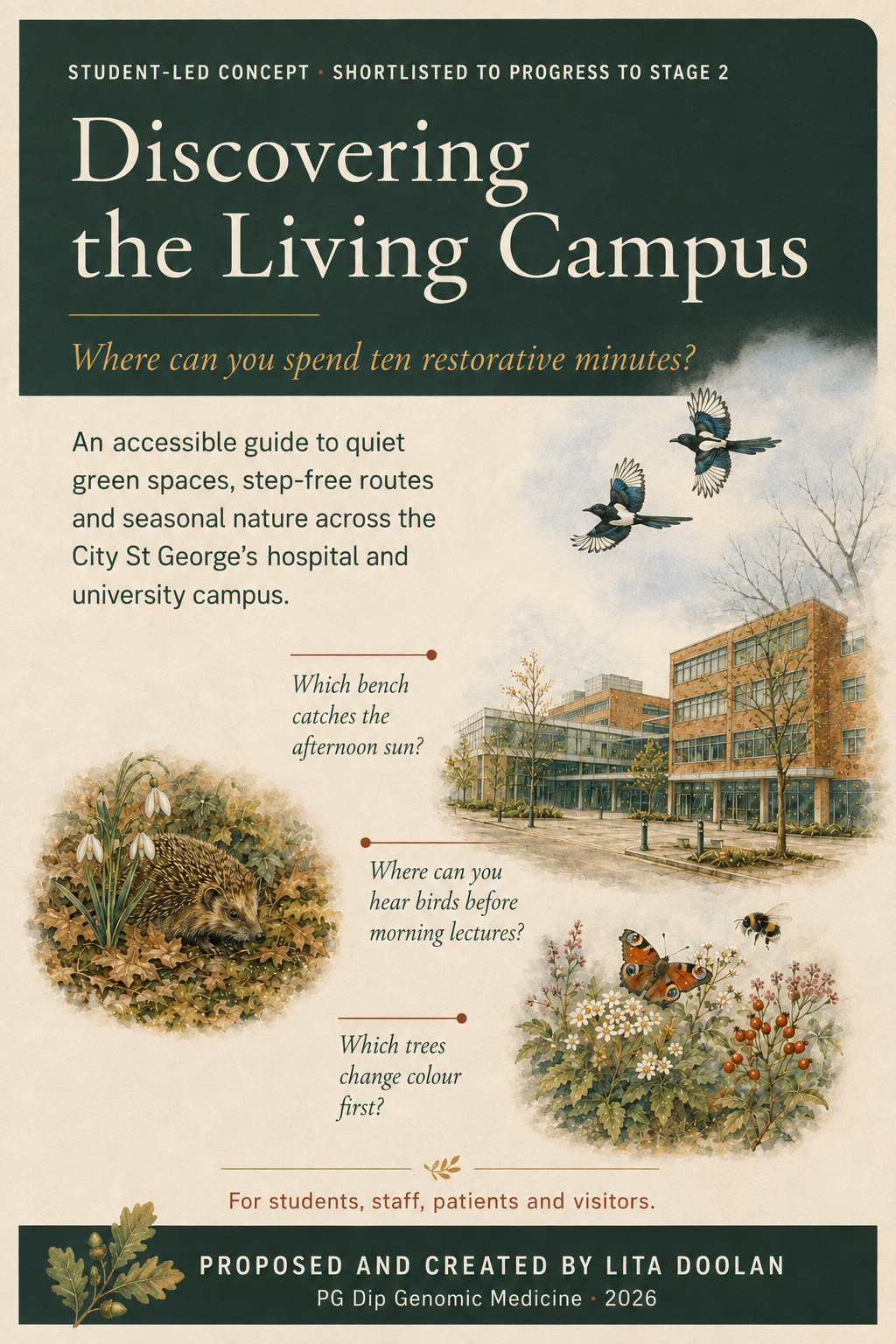
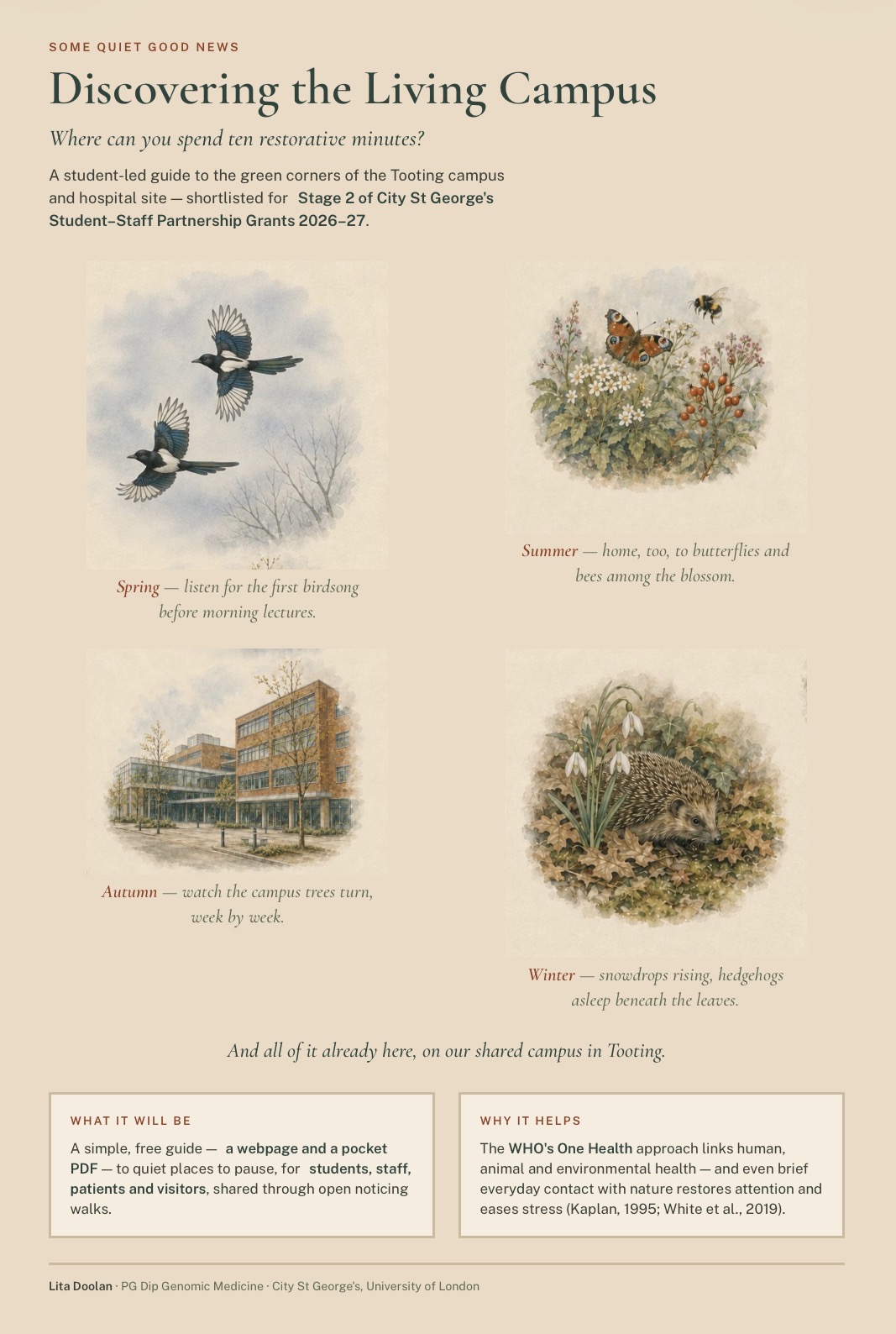
Some good news to share, quietly: my student-led proposal, Discovering the Living Campus, has been shortlisted for Stage 2 of the Student–Staff Partnership Grants (2026–27) at City St George’s, University of London. The panel called it distinctive, which was kind of them; to me it still feels like the simplest idea. Maybe because it began with one question. Where can you spend ten restorative minutes?
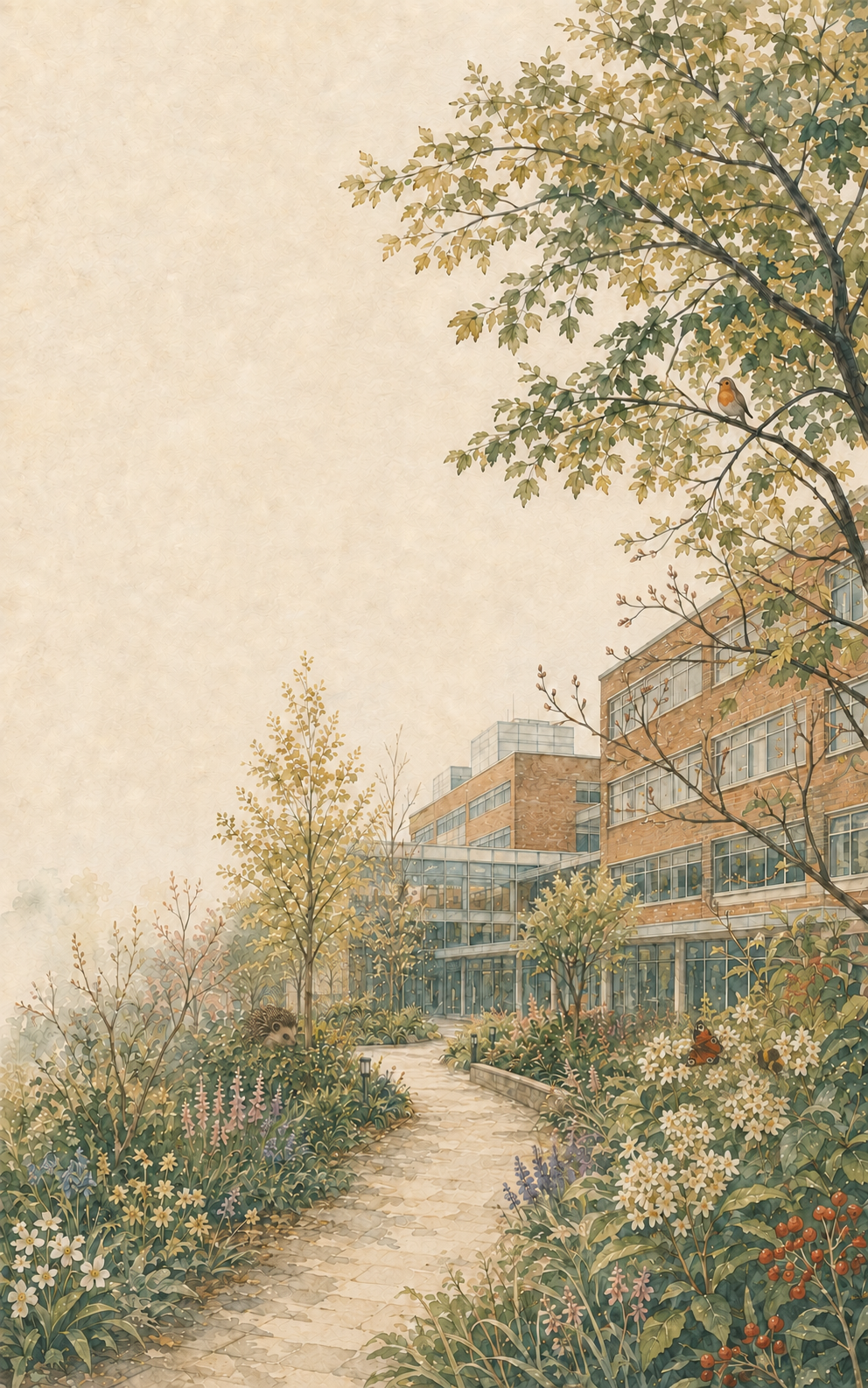
Anyone who works, studies or waits around a hospital site knows the particular texture of its days. Some days are scheduled to the minute and yet full of unclaimed pauses The buildings are full; the day is full. And running right through it, mostly unnoticed, is another day altogether. Hidden green spaces which offer a chance to connect to wildlife that goes unnoticed are featured. In one moment we can share the space with the slower rhythm of nature.
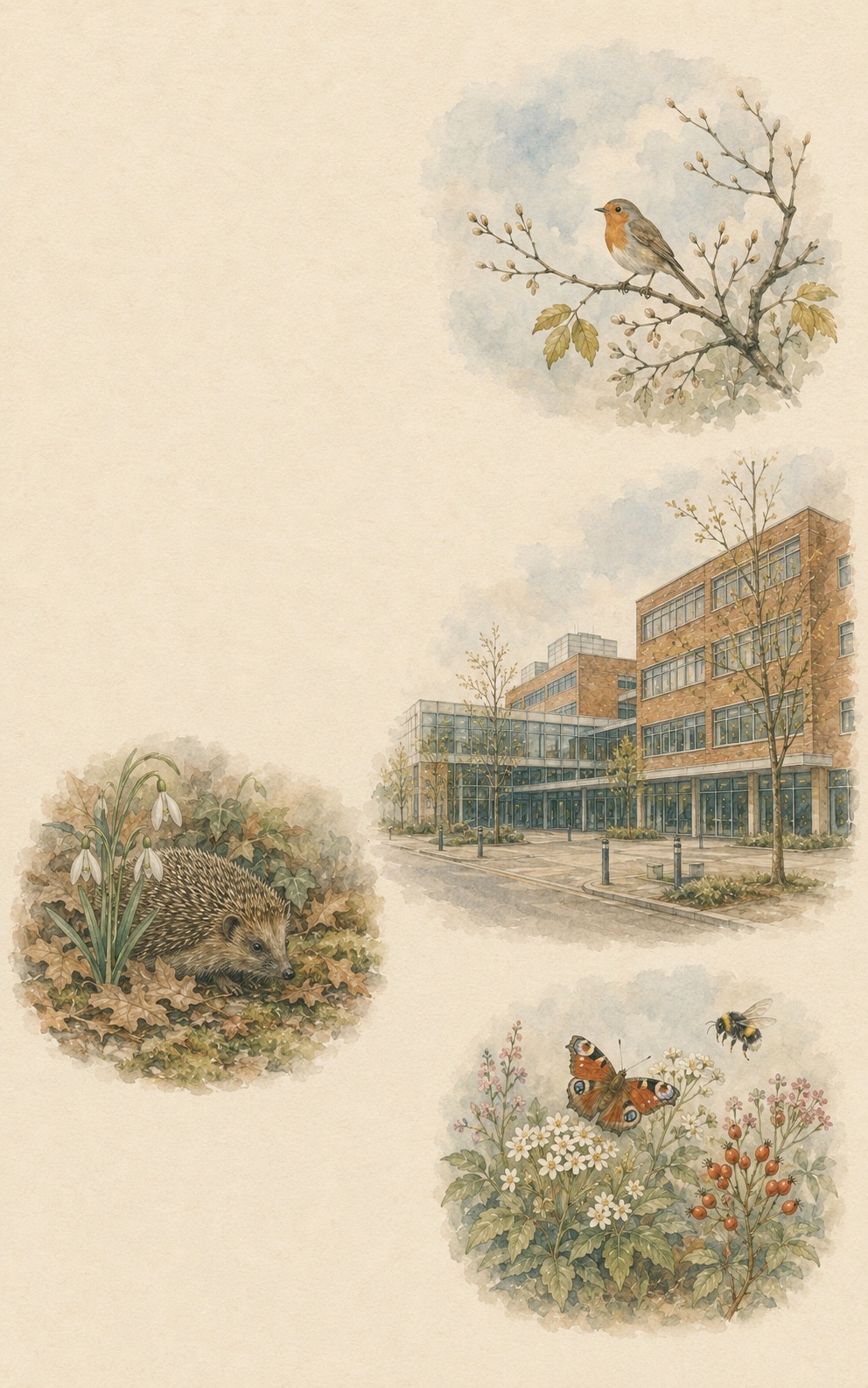
Because nature does not wait for us to be less busy. It happens in sync with our shifts and seminars, on its own faithful timetable. The first birdsong of the morning starts up whether or not anyone on the early rota hears it — and if you do hear it, walking in through the half-light, it lands like a small message meant for you. There is a hedgehog I think of often, so perfectly disguised against the leaf litter by the exit gate railing that it takes a moment of honest doubt — leaves, or creature? — before it resolves into an animal, going about its own unhurried business a metre from the security barrier. And in summer, if you look up at the right moment between one building and the next, there are birds overhead newly arrived from hot countries — travellers from Africa hunting insects above the car park, entirely indifferent to the fact that they are performing one of the great feats of the living world over a hospital in Tooting.
What interests me is what these moments do. They last seconds, and yet they ground us. For that instant you are not a student with an exam or a clinician with a list; you are simply a creature among other creatures, standing in a shared morning. The science on this is better than most people realise. Roger Ulrich’s famous 1984 study found that patients whose hospital windows faced trees recovered faster and needed less pain relief than those facing a brick wall. Rachel and Stephen Kaplan’s work on attention restoration showed why: natural detail engages us gently, effortlessly, and lets our depleted, directed attention recover. More recently, Miles Richardson and colleagues put it in a phrase I have not been able to improve on — moments, not minutes. It is not the duration of contact with nature that matters most, but the noticing.
That word, noticing, is the whole project.
Discovering the Living Campus is not an ecological survey, and not a wellbeing programme demanding anything of anyone. Just a friendly answer to practical questions: which bench catches the afternoon sun, where you can hear birdsong before morning lectures, which trees turn first in autumn, where the snowdrops come up while the hedgehogs sleep beneath the leaves. The WHO’s One Health framework makes explicit, in its insistence that human, animal and environmental health are one interdependent story.
Making a guide to noticing is a slightly paradoxical act, and I like that about it. You cannot schedule a hedgehog. What you can do is tell someone where to stand, and what month to start listening, and let the campus do the rest. In that sense the guide is really a set of invitations — small, undemanding, renewable each season — to step briefly out of the institutional day and into the other one running alongside it. As time evolves I look forward to sharing timely photographs of nature moving through it’s colours here from Tooting, South London, to share the joy of a Living Campus.
Stage 2 is next, and I am looking forward to it. In the meantime, if you find yourself on a hospital or university site this week, I can recommend the cheapest intervention in the wellbeing literature: stop for a moment by whatever green thing is nearest, and give it ten seconds of your full attention. The birds from the hot countries will be leaving soon. They are worth looking up for.
References: Kaplan, S. (1995), Journal of Environmental Psychology, 15(3), 169–182 · Richardson, M. et al. (2021), International Journal of Wellbeing, 11(1), 8–33 · Ulrich, R. S. (1984), Science, 224(4647), 420–421 · White, M. P. et al. (2019), Scientific Reports, 9, 7730 · World Health Organization (2022), One Health fact sheet.


